

AI Removes Friction. Dev-X Unlocks Creativity.
Anyone can generate a tool now. Making one people actually use, and like using, is the same hard problem it always was.
The screenshot test
You can take a screenshot of a tool today and have an AI rebuild a working version of it by the afternoon. Generation is becoming a commodity. If that's all a partner offers, you don't need the partner.
So what's left? Everything that was always hard. Knowing what's worth building. Knowing who it's for. Knowing how it should feel in their hands. The output got cheap; the judgment didn't.
The tool that teaches
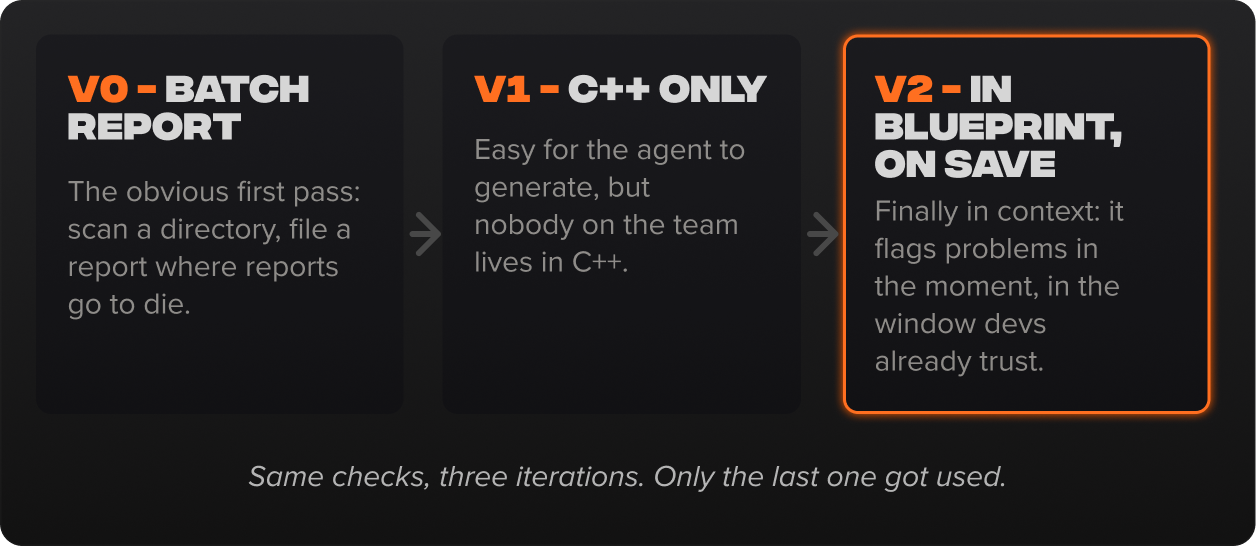
Take the UMG validator we built. A client project had hundreds of UI assets, many built wrong in ways that quietly hurt performance, and no time on the schedule to hand-check them. Our job was to catch those mistakes.
The obvious version is a batch scanner: point it at a directory, get a report, file the report wherever reports go to die.
The first feedback we got made the same point from the other direction. V1 was C++ only, because the agent writes code easily and I figured code would make everyone happy.
It turns out: nobody reads a report. They learn the project's rules while they work.
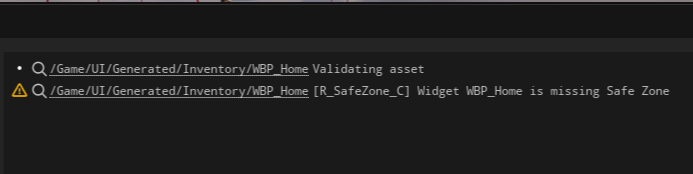
The next iteration rides Unreal's own validation system. Every save and compile flags problems in the moment, in the same window devs already trust, with a message that says what's wrong and why.
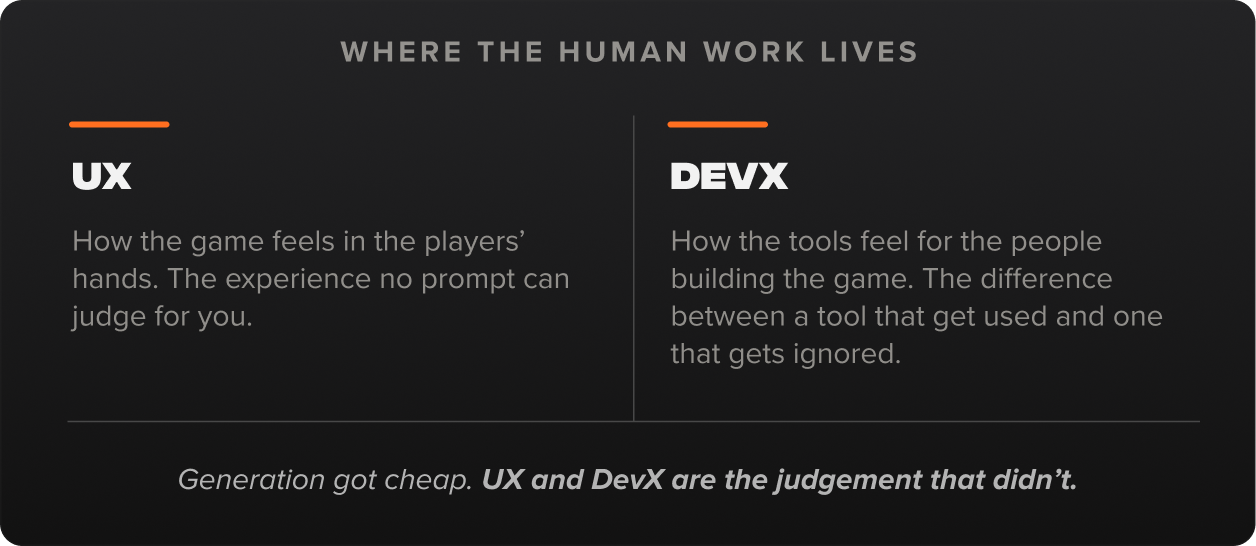
"We use the terms UX for players and DevX for the people building the game."
The team lives in Blueprint. Tools meet people where they are, or they don't get used.
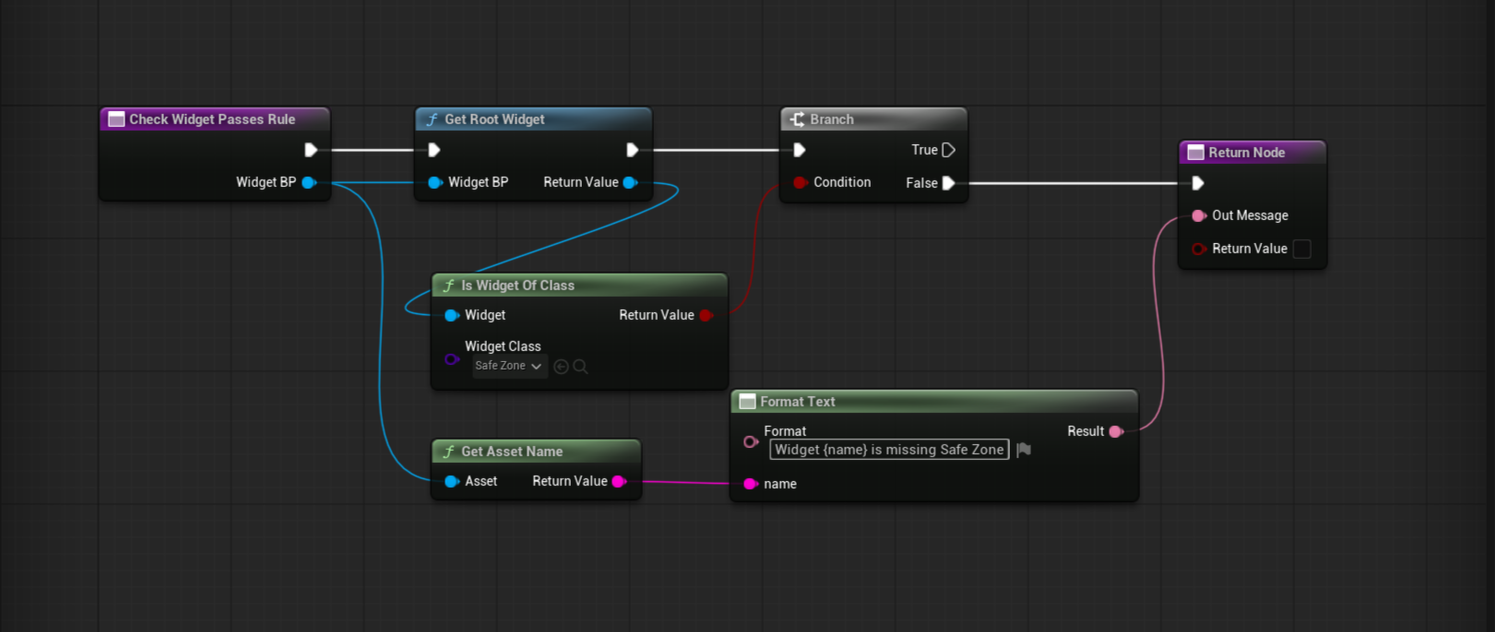
That choice isn't a coding decision. It's a DevX decision, and it's the difference between a tool that gets used and a tool that gets ignored.

Sound code isn't good UX
We learned the limits the same way. A 2D particle system came out of the agent structurally sound and visually flat (more on that in a forthcoming blog). Working code is not the same as something that feels good to use. The polish, the feel, the thing that makes a tool delightful instead of merely functional: that still takes a person with an eye, asking the questions no prompt asks on its own. How should this feel? Why would anyone be excited to reach for it?
The best tools make you feel capable. There's no line of code attached to that feeling. It's decisions, stacked, about how the whole thing feels, and that part is still very human.
Our approach at UX is Fine
AI removes the implementation tax. What it leaves behind is the human work: hearing the frustration, deciding what's worth building, and judging whether the result actually unlocks the person using it.
Our approach is to meet our partners where they are on their AI journey and take them where they want to go. This can be more AI or no AI. We are transparent and respectful of their decisions.
This is what clients are looking for now. Not generated output. Not an overengineered process. But a partner who knows that tools are there to help creatives, and that the tools that delight are tools that will get used.

Mike McMahon is the Studio Engineering Director at UX is Fine, where he bridges the gap between high-fidelity design and scalable game interfaces. A former founding engineer and front-end architect, he’s built patented technology and scaled cloud ecosystems within AWS. From C++ and Unreal Engine to TypeScript and AI agents. He’s obsessed with using AI to collapse the distance between a creative vision and a functional product.
